

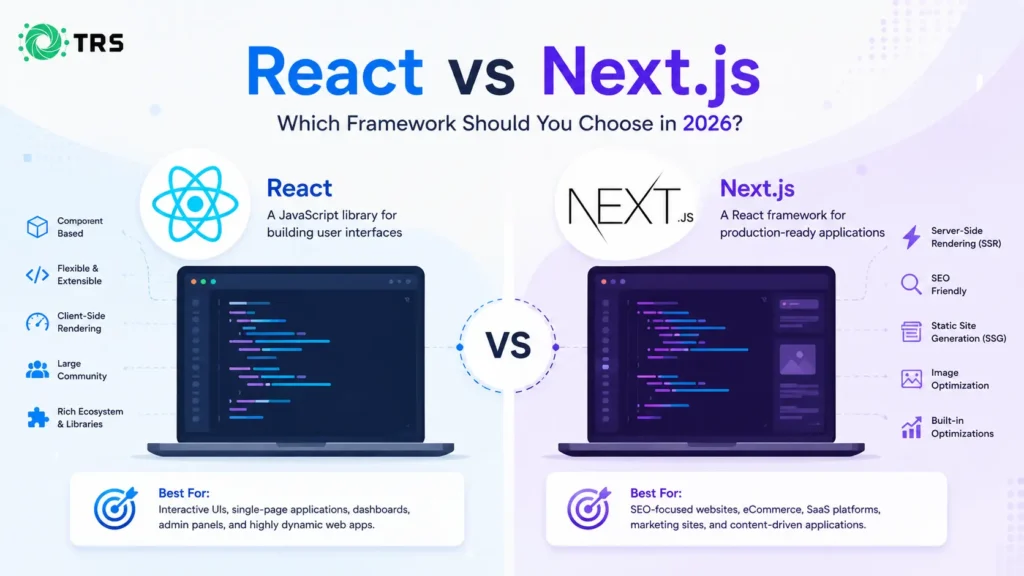
Choosing the right JavaScript framework can significantly impact the success of your web project. As businesses continue investing in modern digital experiences, the debate between React and Next.js has become more relevant than ever. While both technologies are built on the same ecosystem, they serve different purposes and offer unique advantages.
Whether you’re building a startup MVP, an enterprise dashboard, or an eCommerce platform, understanding the strengths of each framework will help you make an informed decision. This guide compares React and Next.js in terms of performance, SEO, scalability, development experience, and business value to help you choose the best option in 2026.
Understanding React
React is a JavaScript library developed for building interactive user interfaces. It allows developers to create reusable components, making applications easier to maintain and scale.
React focuses primarily on the front end, giving developers complete flexibility to choose routing, state management, and backend technologies according to project requirements.
Key Benefits of React
- Component-based architecture
- Large developer community
- Fast rendering with Virtual DOM
- Excellent ecosystem and third-party libraries
- Ideal for single-page applications (SPAs)
Businesses looking for scalable digital solutions often partner with an IT Consulting Company to determine whether React aligns with their technical and business objectives before development begins.
What Is Next.js?
Next.js is a React framework that extends React’s capabilities by adding built-in routing, server-side rendering (SSR), static site generation (SSG), image optimization, and API routes.
Instead of configuring multiple libraries manually, developers receive a production-ready environment that improves performance and search engine visibility.
Key Benefits of Next.js
- Server-side rendering
- Static site generation
- Automatic code splitting
- Built-in SEO optimization
- Faster page loading
- Simplified deployment
These features make Next.js one of the most popular choices for modern business websites and enterprise applications.
React vs Next.js: Feature Comparison
1. Performance
React applications generally render content on the client side. While this creates highly interactive experiences, the initial page load can sometimes be slower.
Next.js improves performance by rendering pages on the server before sending them to users, resulting in faster loading times and better Core Web Vitals.
Winner: Next.js
2. SEO
Search engine optimization has become essential for businesses competing online.
React applications often require additional configuration for proper indexing because most content is rendered in the browser.
Next.js generates HTML on the server, allowing search engines to crawl pages more efficiently and improving organic visibility.
Companies investing in Web Development Services frequently choose Next.js when SEO and content marketing are major business priorities.
Winner: Next.js
3. Development Flexibility
React gives developers complete freedom to select routing libraries, state management solutions, and project structures.
This flexibility makes React suitable for custom applications with highly specific requirements.
Next.js provides an opinionated structure that speeds up development while maintaining consistency across projects.
Winner: Depends on project complexity
4. Scalability
Both frameworks support scalable applications, but Next.js offers built-in optimization features that simplify growth.
Large organizations handling thousands of users benefit from automatic image optimization, lazy loading, and intelligent routing.
Businesses investing in Custom Software Development often prefer Next.js for customer portals, SaaS platforms, and enterprise systems that require high performance and maintainability.
Winner: Next.js
5. Learning Curve
React requires developers to learn additional libraries for routing, state management, authentication, and optimization.
Next.js includes many of these features out of the box, allowing teams to focus more on business logic rather than configuration.
Winner: Next.js for beginners
When Should You Choose React?
React is an excellent choice if your project requires:
- Interactive dashboards
- Single-page applications
- Internal business tools
- Custom admin panels
- Highly dynamic user interfaces
Its flexibility allows development teams to create unique architectures tailored to specific business requirements.
When Should You Choose Next.js?
Next.js is ideal for:
- Business websites
- SaaS platforms
- Enterprise portals
- eCommerce stores
- Marketing websites
- SEO-focused applications
- Content-driven platforms
If your goal is higher Google rankings, better user experience, and improved performance, Next.js provides a strong competitive advantage.
What About Mobile Applications?
Many businesses confuse React with React Native.
React powers web applications, while React Native enables developers to build native mobile applications using similar concepts.
Organizations planning both web and mobile products often invest in Cross-Platform App Development to deliver Android and iOS applications from a shared codebase, reducing costs and accelerating time to market.
Business Considerations Before Choosing
Selecting a framework should never depend solely on popularity. Instead, evaluate:
- Project size
- Budget
- SEO requirements
- Long-term scalability
- Team expertise
- Future maintenance costs
A startup launching an MVP may prioritize speed and SEO with Next.js, while an internal enterprise dashboard may benefit from React’s flexibility.
The right technology decision directly influences user experience, operational efficiency, and long-term growth.
Future Trends in 2026
The web development landscape continues evolving rapidly.
Next.js is gaining widespread adoption due to its performance optimization and server-rendering capabilities, while React remains the foundation for countless modern applications and continues receiving strong community support.
Rather than replacing one another, these technologies complement different business needs.
Companies that understand their objectives before selecting a framework achieve better performance, lower maintenance costs, and improved scalability.
Conclusion
The React vs Next.js debate doesn’t have a universal winner because the best choice depends on your project’s goals.
Choose React if you need complete flexibility, highly interactive interfaces, and custom architecture.
Choose Next.js if SEO, performance, scalability, and faster development are your top priorities.
At True Refined Solutions, we believe technology should support business growth rather than complicate it. By carefully evaluating project requirements and long-term objectives, organizations can select the right framework and build digital products that remain competitive well beyond 2026.