

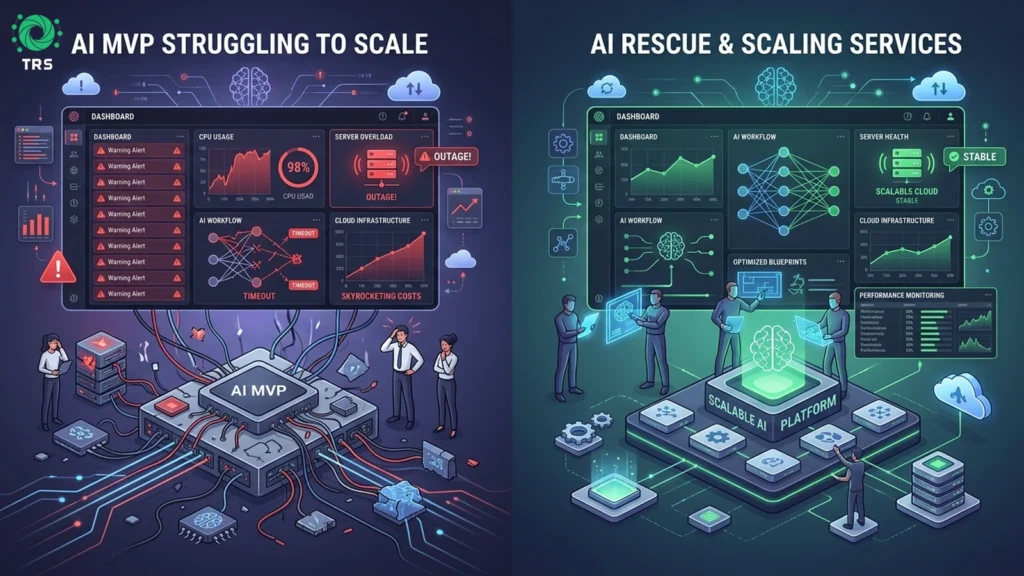
Artificial intelligence has transformed how startups build digital products. Today, businesses can launch AI-powered applications, SaaS platforms, chatbots, and automation tools much faster using modern AI frameworks and APIs. While this speed helps companies validate ideas quickly, most AI-generated MVPs are built for rapid launch rather than long-term scalability. As real users start using the product, issues like slow performance, unstable AI outputs, rising cloud costs, and technical limitations begin to appear. This is why businesses increasingly rely on professional AI MVP Development Services that focus not only on fast development but also on scalability and system stability. In many cases, companies also require AI MVP Rescue Services to optimize underperforming products, improve infrastructure, and prepare AI systems for sustainable growth.
The Hidden Problems with AI-Generated MVPs
AI-powered MVPs have become increasingly popular because they allow startups to enter the market faster. Businesses can now use pre-trained AI models, automation tools, and generative AI frameworks to accelerate development significantly.
However, speed-focused development often creates hidden architectural problems.
Most AI-generated MVPs are built to validate ideas quickly rather than support long-term scalability. As user demand increases, the product starts facing issues such as:
- Slow backend performance
- Infrastructure bottlenecks
- AI response inconsistencies
- High cloud computing costs
- Weak security systems
- Limited scalability
These problems usually appear after launch, when fixing them becomes much more expensive and complex.
Why Most AI MVPs Fail After Launch
Poor Scalability Planning
One of the biggest reasons AI MVPs fail is poor scalability architecture. Many startups prioritize launching quickly and ignore future infrastructure requirements.
Initially, the system may support a small number of users. But once traffic increases, businesses often experience:
- API failures
- Database overload
- Slow AI processing
- Server crashes
- Deployment instability
Without scalable architecture, the MVP becomes difficult to maintain and expensive to optimize later.
This is why businesses increasingly invest in professional AI MVP Development Services that focus on scalable infrastructure from the beginning.
Technical Debt from Rapid Development
Fast MVP launches often involve shortcuts in coding and infrastructure design.
This creates technical debt such as:
- Poor code structure
- Hardcoded workflows
- Weak integrations
- Unoptimized APIs
- Limited modularity
As the product evolves, these issues make scaling more difficult.
Adding new features, integrating advanced AI models, or expanding workflows becomes increasingly expensive and time-consuming. Professional MVP Development Services help reduce technical debt by implementing scalable engineering practices early in the development cycle.
Rising AI Infrastructure Costs
AI systems require large computational resources.
As the product grows, businesses frequently experience rising expenses related to:
- GPU processing
- AI inference
- Cloud hosting
- Data storage
- Real-time processing
Many startups underestimate these operational costs during the MVP phase.
Without proper optimization, cloud expenses can grow faster than revenue.
This is one of the primary reasons businesses seek AI MVP Rescue Services after launch. Rescue teams help optimize infrastructure, reduce unnecessary costs, and improve overall system efficiency.
Inconsistent AI Performance
Another common issue with AI-generated MVPs is inconsistent AI behavior.
During testing, the AI model may appear accurate enough. However, under real-world usage, users begin noticing:
- Inaccurate responses
- AI hallucinations
- Poor recommendations
- Weak automation decisions
- Low personalization quality
These issues quickly reduce user trust and engagement.
AI systems require continuous optimization, retraining, monitoring, and data refinement to maintain reliability at scale.
Why AI MVP Rescue Services Are Critical
Most startups believe rescue services are only necessary when a product completely fails.
In reality, AI MVP Rescue Services are designed to identify and solve technical issues before they become critical business problems.
These services focus on stabilizing underperforming AI products and preparing them for scalable growth.
Common rescue services include:
- Infrastructure optimization
- Cloud cost reduction
- AI model improvement
- Backend restructuring
- Security enhancement
- Deployment stabilization
- Performance optimization
- Workflow automation
Instead of rebuilding the entire platform from scratch, rescue services improve the existing product while preserving business momentum.
This approach saves both time and development costs.
Scaling Is More Important Than Launching
Launching an MVP is only the first stage of product development.
The long-term success of an AI product depends on whether it can:
- Handle growing traffic
- Maintain stable performance
- Deliver accurate AI responses
- Support feature expansion
- Protect user data
- Control operational costs
Many startups focus heavily on launch speed while ignoring scalability planning.
Unfortunately, products built without scalable architecture eventually face major operational challenges.
This is why scalable infrastructure should always be part of the initial product strategy.
The Importance of Agile MVP Development
Agile development remains one of the most effective approaches for AI product growth.
An MVP in Agile helps businesses build products that improve through real user feedback.
Agile MVP strategies allow companies to:
- Launch faster
- Improve continuously
- Test product assumptions
- Reduce business risk
- Scale gradually
Combining agile methodologies with scalable AI architecture creates stronger long-term products.
How to Choose the Right AI MVP Development Partner
Selecting the right development partner plays a major role in product success.
The best AI MVP Development Services providers focus on both rapid execution and long-term scalability.
Businesses should look for teams with expertise in:
- AI engineering
- Cloud architecture
- Infrastructure scaling
- DevOps systems
- AI optimization
- Security implementation
- Product rescue strategies
A strong development partner helps businesses avoid the common mistakes that cause AI MVPs to fail after launch.
Signs Your AI MVP Needs Rescue Services
Your AI product may already require optimization if you are experiencing:
- Slow application performance
- Increasing infrastructure costs
- Frequent downtime
- AI output inaccuracies
- Security vulnerabilities
- Deployment issues
- Scalability limitations
- Difficulty adding features
Addressing these problems early prevents larger technical and financial challenges later.
Conclusion
AI has made MVP development faster and more accessible than ever, but speed alone does not guarantee long-term success. Most AI-generated MVPs fail because they are built for quick launches instead of scalability, leading to issues like weak infrastructure, rising cloud costs, technical debt, and inconsistent AI performance. This is why businesses rely on professional AI MVP Development Services that focus on scalable architecture and sustainable growth. And when products begin facing performance or scalability issues after launch, AI MVP Rescue Services become essential for optimizing infrastructure, reducing costs, and stabilizing AI systems for long-term success.